
Dental implants in Medellin
When a person loses one or more teeth in the upper or lower jaw, the maxillary bone is reabsorbed due to lack of stimulation and, therefore, a loss of bone height and width occurs. This loss can be caused by factors such as age, periodontal disease or the use of removable prostheses.
In these cases, in order to rehabilitate the teeth, it is necessary and advisable to use zygomatic implants (also called zygomatic implants). These are a type of fixed dental implants used in patients without sufficient quality or quantity of maxillary bone to introduce conventional dental implants or bone grafts.
Furthermore, in edentulous patients this bone resorption is considerable, therefore, the placement of conventional implants is impossible but zygomatic implants in the upper or lower jaw are recommended.
Zygomatic implants have a high level of success in people who have been toothless for many years, since the zygoma bone offers an ideal surface for anchoring and osseointegration of the implants, giving long-term results.
Where is the zygomatic bone located?
The zygomatic bone, also called the cheek bone, cheekbone, malar bone or jugal bone, is a paired, lateral, short and irregular bone, located on the external part of the face between the frontal bone, sphenoid bone, temporal bone and the maxillary bone. It should be noted that this bone is responsible for forming the cheekbone of the face and part of the orbit.
Specialists in dental implants and oral rehabilitation
How are zygomatic implants placed?
Zygomatic implants are placed in two phases. In the first phase, a temporary dental prosthesis is placed and in the second phase, once the gum has healed, the definitive prosthesis is placed.
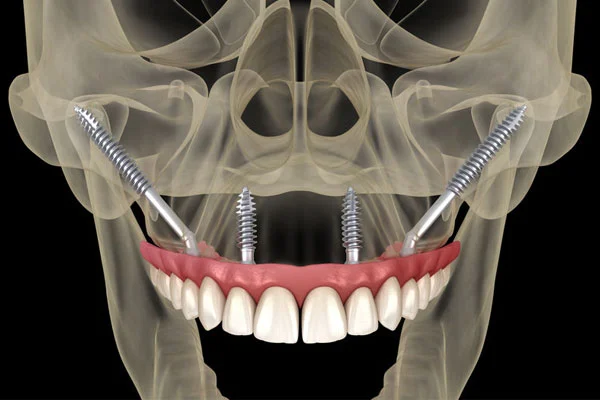
The temporary full-arch denture that is fixed in the first phase will allow the patient to have new teeth from the first day of treatment, reducing the waiting time. Once the bone and gum tissue have healed, this temporary prosthesis will be replaced by a fixed denture that will be the patient's new, definitive smile.
During this treatment carried out at the Oral Studio dental clinic, under local anesthesia or conscious sedation, implantologist José Fernando Espitia will fix four zygomatic implants in the patient's cheek bone or two zygomatic implants in combination with two or four conventional implants.
Unlike a conventional osseointegrated implant in the upper or lower jaw, which is fixed to the jaw, zygomatic implants are placed diagonally in the zygomatic bone, i.e. in the bony arch of the cheek. This is why this type of fixed dental implant measures approximately 35 to 55 mm.
Recovery from this procedure can last between 24 and 48 hours, with the stitches being removed approximately one week after the procedure. In addition, the patient must have monthly check-ups with the specialist for at least 6 months so that dental progress and periodontal status can be assessed.
Read also: Dental implants: the treatment to recover your smile
Get your smile back with José Fernando Espitia The best implantologist in Medellín Now you can finance your treatment
Zygomatic implants: surgical techniques
The 4 most prominent surgical techniques used for the fixation of zygomatic implants are the Branemark technique, the Stella and Warner technique, the externalized technique and the ZAGA technique. Below, we explain each of them:
- Branemark technique: This technique consists of placing the zygomatic implants through the maxillary sinus until reaching the zygomatic arch.
- Stella and Warner Technique: also known as the Sinus Slot Technique, is an alternative to the Branemark technique that allows the placement of zygomatic implants in a more axial position. This axial position results in the initial part of the implant emerging at the level of the first molar, significantly improving the outcome of the prosthetic rehabilitation.
- Externalized technique: During this technique, zygomatic implants are placed externally to the upper jaw bone and are anchored only in the malar. The externalized technique seeks to perform fewer surgical steps, be less invasive and reduce surgical time.
- ZAGA Technique: The Zygoma Anatomy-Guided Approach is a technique that is neither intrasinusal nor fully externalized. The ZAGA technique promotes individualized surgery, tailored to the patient's zygomatic anatomy.
It should be noted that the choice of any of these techniques will be defined by the implantologist who will take into account the concavity formed by the alveolar ridge, the maxillary sinus and the region of the zygomatic bone that will receive the implant.
Zygomatic implants in Colombia
Zygomatic implants in Colombia are an ideal solution for edentulous patients and an effective alternative to replace the use of bone graft materials. This procedure offers permanent results over time and with minimal discomfort after the initial intervention.
With these types of fixed dental implants, the patient will have the possibility of recovering not only chewing but also their self-esteem and facial aesthetics.
If you have been without teeth in your upper or lower jaw for many years, it is time to get your smile back. Agenda now make an appointment with the best implantologist in Medellin and ask about the zygomatic implant procedure at Oral Studio.


